The 21-Mile Gamble: Why the Strait of Hormuz Still Holds the Global Economy Hostage
Roughly one-fifth of the world's oil supply moves through the Strait of Hormuz each day. As tensions rise across West Asia, this narrow waterway once again sits at the center of global economic risk.
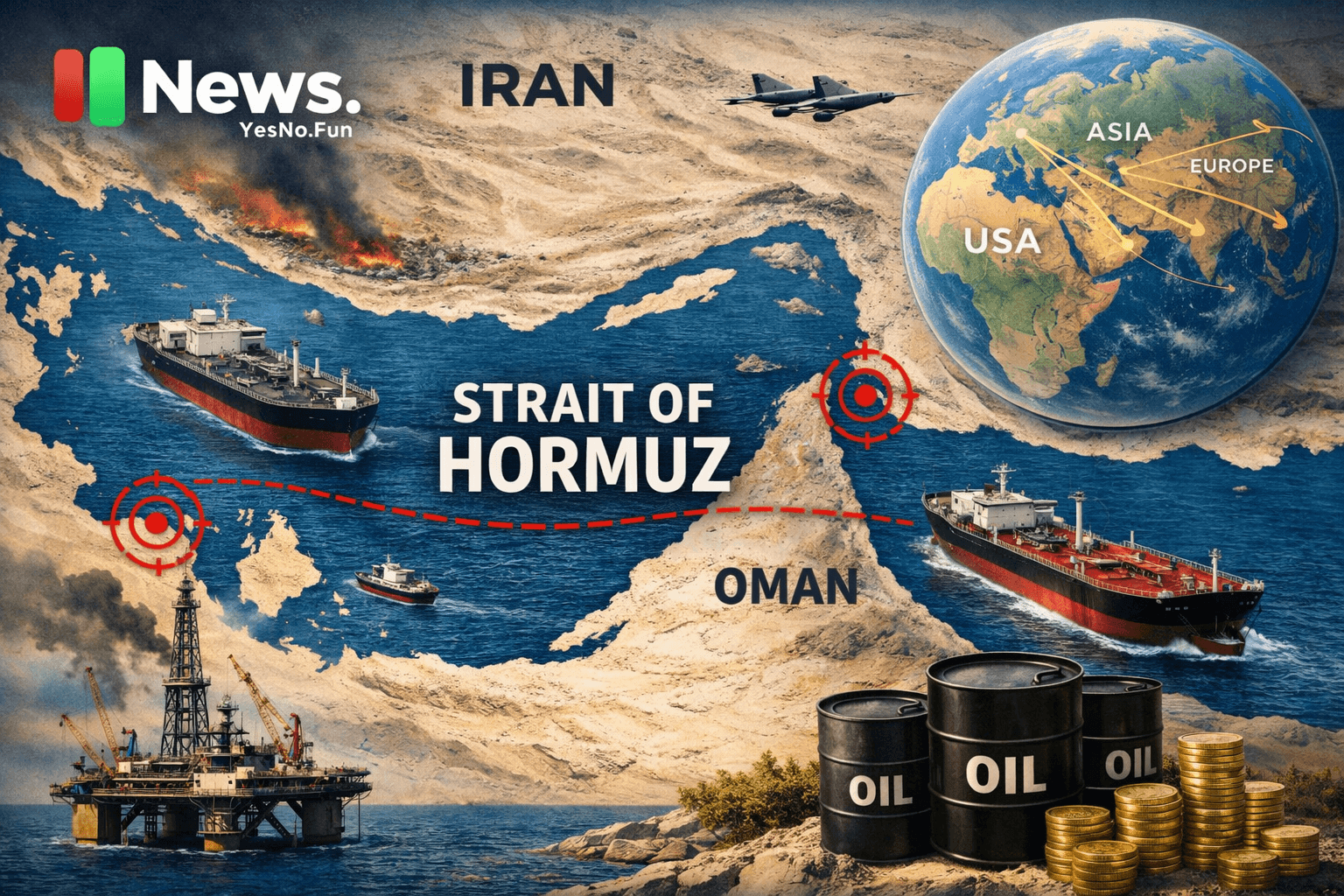
The Strait of Hormuz is the world's most critical oil chokepoint, with nearly 20 million barrels of crude passing through daily.
A Narrow Passage With Global Consequences
On a world map, it looks like little more than a wrinkle in the coastline separating the Persian Gulf from the open ocean. But geography has a way of disguising its importance. The Strait of Hormuz, a narrow corridor between Iran and Oman, is arguably the most strategically significant waterway in the global economy.
Roughly 20 million barrels of crude oil pass through this channel every single day, representing about one-fifth of global petroleum consumption. That volume of energy supply is effectively squeezed through a maritime corridor barely 21 miles wide at its narrowest point.
When that much of the world’s energy flows through a single geographic bottleneck, the boundary between regional politics and global economic shock disappears almost instantly.
The Tinderbox Is Smoking Again
The Strait of Hormuz has never been far from geopolitical tension, but the situation has once again moved into sharper focus.
Escalating friction involving Iran, Israel, the United States, and several Arab states across West Asia has raised fears that the region could drift toward a broader confrontation. Retaliatory strikes, military posturing, and increasingly aggressive rhetoric have pushed the corridor back into the spotlight of global markets.
Energy traders, shipping companies, and insurers do not wait for a tanker to be hit before reacting. The mere possibility that traffic through the strait could be disrupted is enough to send ripples through commodity markets and maritime insurance costs.
For global markets, the credibility of the threat often matters as much as the threat itself.
The Anatomy of a Chokepoint
The reason the world watches Hormuz so closely becomes clear when examining the countries whose economies depend on it.
Several of the world’s largest oil exporters ship the majority of their energy through this narrow waterway:
• Saudi Arabia
• Iraq
• Kuwait
• United Arab Emirates
• Qatar
Together, these producers supply enormous volumes of crude oil and liquefied natural gas to the global economy. Much of that energy ultimately flows eastward to industrial powerhouses such as China, India, Japan, and South Korea.
For these countries, stability in the Strait of Hormuz is not a distant geopolitical concern — it is directly tied to domestic energy prices, economic stability, and political pressure at home.
The Market Playbook
Whenever tensions around the Strait escalate, global markets tend to follow a familiar script.
The first reaction appears in the oil market. Prices often rise rapidly as traders price in the possibility of supply disruptions — even before any actual interruption occurs.
Next comes the shipping industry. Insurance premiums for tankers operating in the Gulf region can climb sharply as underwriters reassess the risk of conflict.
From there, the ripple effects spread outward. Higher energy costs filter into transportation, manufacturing, and eventually consumer prices. Inflation expectations shift, and central banks suddenly face new uncertainties that originate not from economic policy, but from geopolitical risk.
In today’s interconnected economy, the cost of a geopolitical flare-up in the Gulf can be felt thousands of miles away.
Why the World Cannot Easily Bypass Hormuz
In theory, pipelines could reduce the global dependence on the Strait of Hormuz. In practice, those alternatives remain limited.
Saudi Arabia operates an east-west pipeline that can move some oil exports to ports on the Red Sea, allowing shipments to bypass the strait. The United Arab Emirates also operates infrastructure that connects Gulf oil fields to terminals outside the Strait.
But these routes can only handle a fraction of the energy volume that normally passes through Hormuz.
The reality is simple: the global oil trade still depends heavily on massive supertankers crossing this corridor. The scale of the maritime flow is simply too large for pipelines to fully replace.
A Regional Conflict With Global Impact
The uncomfortable truth about modern energy markets is that regional conflicts rarely stay regional.
Tensions involving Iran, Israel, and the United States may begin as geopolitical disputes, but the economic consequences quickly spill across continents.
A confrontation near the Strait of Hormuz can influence everything from global oil prices to shipping routes, inflation forecasts, and investor sentiment.
In an era of globalized trade, the stability of this narrow waterway carries implications far beyond the Middle East.
Watching the Water
The Strait of Hormuz is a reminder that geography still dictates much of the world’s economic reality.
Despite the digital transformation of finance and commerce, the global economy remains deeply dependent on the physical movement of energy and resources. And a significant portion of that movement continues to pass through a single maritime corridor between two coastlines.
Whenever tensions rise in West Asia, investors, policymakers, and traders instinctively focus on that narrow stretch of water.
Because for all of the world’s technological progress, the global economy still flows through a 21-mile-wide gamble.